Sunday, February 13, 2011

Cloudy With a Chance of Meatballs (2009)


"My chest hairs are tingling. Something's wrong." 
                                                               - Earl Devereaux 

It's not the best or most realistic looking CGI film out there (though some scenes are really something to marvel at), it's not; Cloudy With a Chance of Meatballs it's just a good story with a lot of heart and and and it's funny! 


It’s a bit goofier in its animation style than say a Shrek or Toy Story. Bug eyed reaction shots and exaggerated poses are found all throughout, but it works here. Right alongside the sight gags and slapstick, this cartoonish style has an appeal and charm to it that matches the tone of the story well.
The protagonist, Flint Lockwood, has worked since childhood to invent something special. He finally accidentally creates the FLDSMDFR (pronounced just like it reads) that makes it rain various food. What seems fantastic turns problematic and eventually becomes a sentient being that must be taken down (as these things usually do). It’s fantasy based in reality, much like the animation style of the film. 

There really is something about these computer animated films; they capture heart and emotion so well. The best of this genre knows how to funnel this emotional appeal to both kids and adults at once. I imagine the plot, with its themes of being yourself and love (staples of most kids’ movies nowadays), and the visuals appeal to kids while the pop references and celebrity voice casting maintain the adults’ interests. The casting of Mr. T is amazing here. Really, it’s nothing short of perfection when we says the name Flint Lockwood. 

See it. It's dope. 

Saturday, January 29, 2011

Jesus Camp (2006)


"We believe that there's two kinds of people in this world: people who love Jesus and people who don't."
                                                                  -Levi's Mom 


Watching a preteen Christian speaking in tongues while tears stream down their cheeks is intense. Watching them fall to the ground in tears while asking their God for forgiveness feels intrusive. Jesus Camp takes us into the lives of Evangelical Christians and like any good doc it sparks intense conversation, thought, and a variety of emotion.

Largely set in the Midwest US we follow kids like Levi. At 12 years old, we watch as he’s tutored in how to respond to global warming claims and how to respond to those who doubt creationism (which is "the only possible answer to all the questions" his mother assures him). Levi, a kid himself, gives sermons to others younger than him. Like many scenes in this doc the feelings inspired are conflicting. It's exciting to see him practice and do well in front of the crowd yet it's still a bit unsettling to hear such firm beliefs coming from someone so young and inexperienced. Levi is well mannered and polite when he speaks, even when he talks of the "yuckiness" he feels when he comes across non-Christians. This “us vs them” mentality is steady through the documentary and is disconcerting.

The kids presented in Jesus Camp genuinely gather strength from their faith, and they aren't portrayed as blind to doubt or hesitation – for example they are told that Harry Potter is a warlock and not a hero and when one kid admits to watching the films with a smile on his face, others nearby are visibly shocked and excited at the same time. Still, as strong as they appear they are simultaneously portrayed as the fragile beings that they are. They cry so much and so often through the film. They cry when they're happy, sad, fearful, excited...it's powerful and the emotion is so honest. Yet audiences will wonder how much is too much to put on a child. Watching them get lectured about abortion, complete with plastic fetuses to see and hold, is upsetting and feels premature.

The theme of the film seems explore the role children play in the future of Evangelicals’ faith. Repeatedly they are singled out by the adults around them as being vital to the longevity of the Church. It’s an enormous amount of pressure and the approach to the task is interestingly exemplified by the use of two words: train and teach. The distinction between the words is vital and never concretely made throughout the doc. At times the parents claim to be teaching their children the Word of God while other times they are actively training them for what sounds like a war.

Structurally the film is tight and familiar: we’re introduced to the topic of Evangelical Christianity and the kids and adults that we'll follow; then we follow them to religion camp and back. The greatest strength of the doc is that it does well to not poke fingers and make fun, but to show the conflicting sides in a surprising neutral light. The Evangelicals will watch with pride while others will watch in shock and disbelief. The final shot of the film is a telling one. Becky, the religion camp director, drives through a car wash listening to a preacher professing what she already believes. In that moment she’s either being washed over and renewed by hearing her beliefs reinforced to her or she's a deeply confused woman driving through a dark tunnel.

I worry for our kids. I worry that they don't get to be kids as long as they should. I worry that they seem to face so much more information overload and persuasion than I remember facing (though maybe older generations said the same of mine). Nonetheless I worry for them.

(Ted Haggard makes an interesting appearance, chastising homosexuals, considering his sex scandal that emerged in the same year Jesus Camp was released.)

Thursday, January 27, 2011

Hard Candy (2005)

"Your conversational skills are really deteriorating as the day goes on."
              - Hayley


Imagine Little Red Riding Hood except for this time the big bad wolf is captured and tortured. On the surface that may not seem like such a bad thing. After all, the wolf would eat Red Riding Hood given the chance. But at what point of capture and torture would you begin to feel sympathy for the wolf?

This is the central question posited by Hard Candy, and boy does it sit with you. Ellen Page stars as Hayley, a mature teen who takes on a suspected pedophile under the guise of prey. Her target is Jeff, played by Patrick Wilson, and for much of the film we are kept in the dark as to whether he really is the pedophile that Hayley believes him to be. What follows is an engaging reversal as Hayley assumes power and tries to probe the truth from Jeff. One torture scene is particularly cringe worthy for any guy watching and it really makes the audience reconsider how we feel about Hayley, our “hero.” How long do we side with our protagonist when they go down a dark path in search of justice? It’s a question that audiences will mull over long after the film ends.

The film take place over the course of one day and much of the story is progressed through dialogue. The setting is (primarily) limited to Jeff’s house and despite such constraints the pace of the story is steady and never slows down more than necessary. Both Page and Wilson carry much of the film’s success through their performances. Both roles require a level of nuance that matches our complex feelings towards them, and it’s really satisfying to see both actors pull it off. The best story telling experiences stick with us for some time, and for a movie to stick with me this long after its release is quite telling. Definitely worth watching and exploring.

Thursday, January 13, 2011

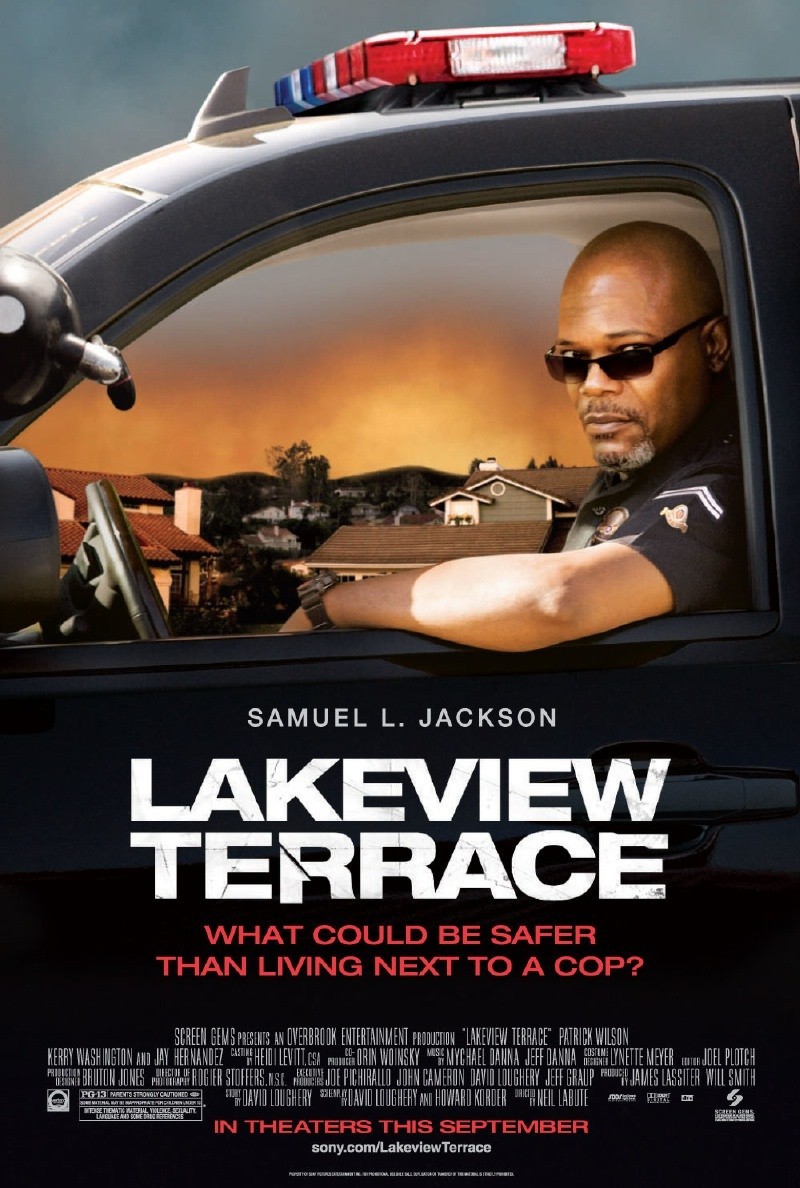
Lakeview Terrace (2008)

"I am the police! You have to do what I say!"
                                                              - Able Turner

Obviously casting can influence how easily an audience relates to a character (some actors are amazing and truly become their characters while others suck) but the influence of casting that is displayed in Lakeview Terrace springs from the audience’s preconceived notions of an actor. We live in a country where we know a lot about our entertainers. Whether we actively follow celebrity news or not, all of us are aware of the stereotypical narratives that are out there: the young Hollywood starlet who parties hard, goes to rehab, and makes a triumphant return; the handsome leading man of action who walks away from buildings as they blow up in slow motion; etc. Rather than ask the audience to suspend their disbelief regarding which actor is playing which role, Lakeview Terrace director Neil LaBute steers into our assumptions. 

The film centers on police veteran Abel Turner, played by Samuel L. Jackson, who terrorizes Chris and Lisa, his new interracial next door neighbors. His disapproval (hell anger) towards the recently married couple isn’t easily apparent at first. Viewers will continue to ask themselves well into the film whether Jackson’s character is actively harassing them or if these incidences are just new neighbors learning each other’s idiosyncrasies. For example, when Chris and Lisa are fooling around in their backyard pool, Abel is upset that they are setting a bad example for his children. Abel buys new floodlights for his backyard to “keep any possible intruders away.” When the floodlights end up being aimed directly into the bedroom of the young couple they naturally take offence. This early exchange is just one example and with each new conflict the feud gets further amplified. 

Still throughout the majority of the movie viewers won’t be fully sure of Abel’s intentions. Is he racist? Is he just uptight? We sympathize with the new couple but we don’t completely demonize Able’s actions; we even make excuses with ourselves for them. This is where the casting influence is apparent. Samuel L. Jackson’s off screen identity causes us to give Able waaaay more leeway than we normally would. Jackson is such a popular actor and likeable with fans that we forgive more than we would a no name actor in this role. This same technique was also used to great effect with the casting of Denzel Washington in Training Day. The idea seems to be if you can’t curb people from bring their knowledge of celebrity culture to your movie, then you should use it to your advantage. It’s a great tool and takes what would otherwise be an average movie and makes it something worth watching.

Friday, January 07, 2011

Hustle and Flow (2005)

"Everybody got to have a dream. You hear me?"
                                                                  - DJay


A movie about a drug dealing pimp trying to make it as a rap star doesn’t sound appealing and it shouldn’t, because that’s lame. Luckily this is not what Hustle and Flow is about. It’s about dreams.

Everybody has a dream, even those of the most despicable corners of society. Why you should see this film, and why it’s incredible, is the gradual shift you feel from despising a guy like DJay to rooting for him. Hard. You’ll watch as DJay treats his prostitute, Nola, like shit. You’ll see him sell drugs. You’ll see him do these things and more and by the third act you’ll want him to succeed in reaching his dream of hip-hop glory. You might even hate yourself for it but you will. The director pulls this off is a number of ways: first, you see DJay work hard at his craft; legitimately, he works at this. We may not all sympathize with him due to the choices he makes, but we can empathize with someone trying hard, struggling and progressing. Secondly, you also see him sacrifice. Finally, and this is my favorite of the director’s methods, the person who stands between DJay and his dream is worse than DJay is. It’s a old but effective trick, placing your unlikable hero in juxtaposition with someone even more unlikable allowing them to shine by default, and it really seals our affection for our drug dealing pimp turned rapper.

All of this is pulled off by a great cast led by Terrence Howard as DJay. It takes a strong performance to help sell an audience on the idea that a character like this is worth investing in. It’s a wise investment on our part and it’s a satisfying pay off. 

Monday, January 03, 2011

Dr. Horrible’s Sing-Along Blog (2008)

"I'm gonna give Penny the night of her life, just because you want her. And I get what you want...She's with Captain Hammer and these [holds up fists] are not the hammer. The hammer is my penis."
           - Captain Hammer 


Poor Dr. Horrible. All he wants is to rule the world. Not merely for the sake of being in charge mind you. He thinks he can do a better job. Poor Dr. Horrible. And you will sympathize for him. When he’s not working on his freeze ray he’s pining after Penny, the girl of his dreams, and avoiding beat downs from his arch-nemesis Captain Hammer (who is dickish enough to make us hate him too).

The backstory of this three act mini movie is really just as interesting as the movie itself. Created during the 2008 WGA strike, writer/director Joss Whedon set out to create a short, yet professional, film that wouldn’t cross any strike regulations. The result is a great little musical about a D list villain named Dr. Horrible trying to earn respect and his way into the Evil League of Evil. Reportedly the film was made of a very limited budget with none of the actors (Neil Patrick Harris, Nathan Fillion, and Felicia Day) paid at the time. It’s a great project and source of hope for any aspiring filmmaker out there who ever complained of a lack of budget. The same could be said for life in general I suppose. We shouldn’t place our happiness externally (“I’d be happy if I just had that car/job/girl/etc”).

Whatever larger messages one takes from Dr. Horrible and his sing-along blog it’s a great little work. Like any good musical the songs are catchy and will stay with you long after you’ve finished watching. Watch Dr. Horrible. Sing along. Laugh. Rule the world.

Tuesday, December 21, 2010

Precious: Based on Push by Sapphire (2009)

"I'm gonna break through or somebody gonna break through to me."
           - Clareece "Precious" Jones


I avoided this movie for some time. I avoided this thing like the fuckin’ plague. Not because I didn’t think it would be good, but because I knew it was going to be a heavy one. This isn’t the kind of movie you throw on when you’re bored; you need to build yourself up to see this. Rest assured it is worth it.

Even if you’ve only given this movie a cursory glance online you’re probably familiar with the plot, so I won’t give it more than a sentence in this blog: Illiterate, overweight, pregnant, teenage black girl from Harlem strives to overcome abuse and better herself. I read that the director was worried that the film would be read as playing into, and up to, stereotypes of black folks. I can understand the concern (there’s the scene where the title character literally runs down the street eating a bucket of stolen fried chicken!) and it’s not unreasonable. But that’s not what bothered me. What stuck with me and made me uncomfortable was how much bad shit happens to one person. Don’t misunderstand, I know these things (rape, incest, verbal/sexual abuse, STDs, etc) unfortunately do happen to people in real life, far more often then we think in fact. But seeing this all play out in the span of a 2 hour movie and to one person is too much and moves towards melodrama. This is unfortunate because melodrama lessens the impact that these topics deserve. I suspect this is something that wasn’t addressed in translating the story from novel to film. A novel can be paced better than a film; a novel breathes in a way that a film doesn’t. A novel can have all of these experiences happen to one character and not be overwhelming. This distinction of medium could have been handled with more nuance.

So why is Precious on my list? Well it’s an incredibly well acted movie. Gabourey Sidibe and Mo’Nique received an enormous amount of praise for their work, and rightly so, but the supporting cast is just as strong. It’s also on my list because these topics are very real and deserve to be addressed. I hesitate on this last point though. Just because a film delves into a topic worth exploring, or offers a positive message, doesn’t make it a worthwhile movie going experience (see any after-school special or Lifetime movie); it still needs to be a good film and story in its own right, despite the topic. And though Precious may not be perfect in this sense it does get way more right than wrong. So it’s worth a watch.

Tuesday, December 14, 2010

The Mist (2007)

"As a species we're fundamentally insane. Put more than two of us in a room, we pick sides and start dreaming up reasons to kill one another. Why do you think we invented politics and religion?”
               - Ollie


A New England town becomes a microcosm of humanity in Frank Darabont’s The Mist. Based on the novella by Stephen King the film is no doubt firmly rooted in the horror genre (it’s tense, scary, and bloody) but it works on more levels than just that. Indeed, the monsters inside the mist are nothing compared to the darkness within ourselves.

A curious mist rolls into town and traps a collection of people in a local supermarket. Slowly they discover that various monsters dwell within the mist and the struggle for survival begins. Things move quickly early on, as they should, and in fact the creatures’ origins are never fully explained because they aren’t what’s important. The story is less about the monsters and more about how we react to extreme circumstances. They function merely as the circumstance for this sampling of people to come together. The supermarket is itself is an interesting, if understated, setting for the film to take place. Just like the suburban mall in Dawn of the Dead, it’s the great equalizer. Everyone, from the educated to the uneducated, high class to working class, can be found in the supermarket and that’s how you get your microcosm. Within this collection of people larger societal sections are also represented, and thoughtfully explored.

Consider Mrs. Carmody who represents the rise and corruption of religion. Early on her claims of the end of days are regarded as crazy ramblings of the town nut; nothing more than nonsense to be ignored. Slowly she gains a following in light of attacks by the mist monsters, and by the film’s third act she’s hailed as a prophet and commands some of her fellow survivors to carry out violent, terrible acts in the name of religion and survival.

Heartbreaking ending notwithstanding, the film’s greatest success, and why it’s worth watching, is in its portrayal of humanity. We’re panicky and we’re organized, we’re altruistic and selfish hypocrites, we’re believers and we’re rational; we are undoubtedly walking contradictions in so many ways. The Mist captures this quality so incredibly well. It’s a shame that the film didn’t garner more attention when released.

Friday, December 03, 2010

The Human Centipede: First Sequence (2010)

"...a Siamese triplet, connected via the gastric system. Ingestion by A, passing through B, to the excretion of C. The human centipede, first sequence."
                                                  - Dr. Heiter 

The Human Centipede: First Sequence is a film with a ridiculous B movie style premise that takes itself so seriously (no winks and nods to the camera) it’s almost engaging. Almost.

Dutch filmmaker Tom Six tells the age old tale of two American tourists in Europe who get lost and end up on the wrong doorstep on a rainy night. Enter Dr. Heiter. Heiter is a mad German scientist (seriously) who dreams of creating the human centipede by linking three humans into one centipede-like creature. You can use your imagination (or Google) to guess how this looks once he successfully reaches his goal. And he does reach his goal. The three victims (the two Americans and a third captive) try to escape, their screams bring the attention of the police, blah blah blah, murder, gunshots, and tragedy ensue.

Does it have a larger message or a theme to be explored? Is it commentary on gruesome Nazi experiments? Hard to say, but no. Not even slightly. This truly seems like an idea that two guys kicked around while they were high and then actually followed through on it.

Be warned that there are some truly gross scenes here. That said, it’s not a very graphic movie (very little gore or nudity involved) and yet still very disturbing which, incidentally, is a pretty neat thing to pull off. So why should you see it? See it because it’s ridiculous. See it because the acting is so very, very bad. See it because it’s a gross out movie. See it because it’s stupid and marvel at the fact that someone actually financed a movie like this to be made…and because there’s a sequel due out next year. It really is fascinating to think about the development process with a movie like this. What did it look like to pitch this idea to investors? What was the casting process like? Hmmm...

Have a drink and watch it with friends; it’ll be funnier.

Thursday, December 02, 2010

Big Fan (2009)

“You didn’t have to be mean. Everybody’s always so mean. It wears me out.”
                     - Paul

Robert D. Siegel’s Big Fan is an engrossing look into a diehard fan. It’s completely engaging and tragic and uplifting all at once.

Paul from Staten Island lives in boxes. He’s a parking garage attendant. He lives with his mother. He has one friend. He has one obsession: Giants’ football (though he won’t dare step foot inside Giants stadium – real fans watch from the parking lot while tailgating). He’s got one hobby: calling into a sports radio station. A meticulous hobby, he doesn’t just call in. He writes down what he’ll say, rehearses it out loud before he calls in and after he "nails it," he casually tells his friend that he was just wingin’ it.

Paul won’t take your pity; he chooses this life. It’s not that he’s socially awkward or can’t interact with society in a larger way, it’s that he doesn’t want to. It's his dedication and unconditional love of something greater than himself that he values and when we recognizes that others lack that kind of passion he's uninterested in them.

Paul and his friend tail their favorite player, Quantrell Bishop, to a club one night and through some unfortunate miscommunication Paul gets brutally beaten up by Bishop. Putting his love for football over his own self interest Paul tries to ignore how his hobby turned on him. From this choice spirals a host of effects that Paul fights to regain control of. All of this ends with a climatic showdown with his radio rival in a scene that is pure brilliance and pure Paul, through and through. You’ll cheer. Trust me.  

Paul is played by comedian Patton Oswalt and holy hell does he do an amazing job. A character like this could easily spin into caricature or stereotype, but with subtlety and honesty in Oswalt's performance it never does.

Wednesday, November 24, 2010

I'm Reed Fish (2006)

"And with that, my friends... have a marvelous day in the Meadows."
                - Reed Fish

I’m Reed Fish is a quiet little movie as charming as the town in which it takes place. I guess it would fall under the category of romantic comedy, but don’t let the negative connotation cause hesitation; you’ll enjoy it.

Reed Fish works at the radio station of a town named Mud Meadows (seriously, I know, but stay with me) so small that everyone listens to Reed for news and they call in for him to help settle small disputes.   Despite how antiquated this may sound, it rings so true that you really buy into this small town life and Reed’s unique place within it. Soon to be married to his long time girlfriend, Reed’s world is rocked when his old crush returns to the home town. As you can probably surmise Reed messes up and has to win back the girl he plans to marry. This is where I have to urge you again to not relegate this to just another romantic comedy with the same banal plot. You have seen this story before, I concede that, but the resolution is one that is so unique and surprising (albeit a bit confusing) that you’ll be won over.

I should mention at this point that Reed’s girlfriend is played by Alexis Bledel (who does a fine job), but the surprise performance is that of Jay Baruchel as the titular character. You probably don’t know Baruchel by name and you only might know him from his small part in Knocked Up or his lead roles in She’s Out of My League and The Sorcerer's Apprentice.

If you still don’t know who he is that’s exactly why he’s such a pleasant surprise as Reed Fish.
See it. Trust me. 

Monday, November 22, 2010

Good Dick (2008)

"That was an incredibly odd exchange."
                                                         - Simon

Marianna Palka's Good Dick is a fascinating romantic drama with a take that on the genre that you probably haven’t seen before (or at least done this well).

A woman who goes to her local video store daily to rent soft core porn becomes the object of affection for the video clerk. It’s a simple situational setup that masks the layers beneath. The woman is cold and distant and seemingly not interested in a relationship, of any kind, despite the constant attempts by the video clerk. In fact she treats him pretty shitty. Not until the end of the film when we meet her father do we really understand her. She’s been sexually abused by him, the first man in her life, and that shapes how she interacts with other men. The clerk too isn’t without issues to be addressed. He’s battled drug addiction which may explain his addictive personality and why he won’t give up on her despite the vitriolic insults and humiliation she dishes.

It’s been said that hurt people hurt people, and that concept is exemplified well in this film. She treats him like shit because that’s what she knows. She maintains control of their relationship because she knows how awful it feels to be the one being controlled (It now becomes interesting that her erotic interests lie in soft core porn: porn without penetration as the clerk tells her). Many times throughout the film she dominates him (even simulating rape) to humiliation, and it’s painfully clear that she’s been through hell.

Through it all we are left with a hopeful ending. A confrontation with her father and reconciliation with her video clerk are small steps in her progression. In the end we’re left with two damaged people moving forward together. Hopeful, indeed.

(Be careful Googling this one - the title may lead you to the dark side of the web!)

Saturday, November 20, 2010

The History Boys (2006)

“They’re clever…but they're crass”
                                                 - Headmaster Felix

2006’s The History Boys is a film adaptation of the popular play of the same name. The original director, writer, and cast are all on hand making its transition as seamless as possible, if not, as some critics say, even better. It’s a story so thoughtful and bursting with content that there are no throw away lines; everything is purposed.

In 1983 Sheffield, England 8 boys are nearing graduation and after receiving the school’s highest marks are aiming at getting accepted into Oxford or Cambridge. They’re a book smart group and confident too (able to quote you well under the table). Diffidence isn’t a problem for them, but what they have in confidence they lack in refinement and the creative thinking that becomes their real education. Enter Irwin - new teacher hired to give them a polish. “You get a question, you know the answer. But then, so does everybody else. So, say something different, say the opposite…A question is about what you know, it's not about what you don't know,” he urges them.  

A varied group, the youngest of the boys is (possibly) homosexual and in love with Dakin, the most charismatic of his classmates. I mention this in particular because subplots of homosexuality run throughout the film. While Dakin dismisses his young classmate’s affection Dakin himself is drawn to Irwin. All of this parallels another subplot of Hector, a long standing teaching exposed of having fondled several of the boys who both acknowledge and just as easily dismiss the action as no big deal. The fondling is thought of as “more appreciative than investigatory” (as it’s described at one point of the story). The casual way all of this is explored is…different and unexpected and because of that it’s really engaging.

You’ll want to watch with subtitles on, though not because the accents are too tough, but because you won’t want to miss a word. Nearly every line is so carefully constructed and witty you’ll wish it were a novel so that I could savor them better. The History Boys is such a well crafted film exploring self-reflection, education, and knowledge. I hope that you find connection to it (and to good story telling in general), because as Hector says, The best moments in reading are when you come across something - a thought, a feeling, a way of looking at things - that you'd thought special, particular to you. And here it is, set down by someone else, a person you've never met, maybe even someone long dead. And it's as if a hand has come out, and taken yours.” 

Thursday, November 18, 2010

Do the Right Thing (1989)

"Let me tell you the story of Right Hand, Left Hand..." 
                                                                  - Radio Raheem

Do the Right Thing is a classic. What could I possibly add to it that hasn’t been said already, right? Well I’ll say this: this is a movie that makes you feel something. There’s no way you can watch this and not need to talk about it with someone afterwards. And that is truly the mark of a quality cinematic experience (hell, any story telling experience really). Whether you think Mookie did the right thing in the end, whether you think Sal is the villain, or even if you think Buggin' Out was the true cause of Radio Raheem’s unfortunate death you can’t walk away from this film without an opinion.

Most summaries of this Spike Lee joint (yeah, I said joint) state something along the lines of how on the hottest summer day in Brooklyn racial tensions come to a boil. While most one liners understate a story’s nuance for the sake of brevity, trying to boil Do the Right Thing down to a one liner is underselling the major accomplishment that Lee achieved. The landscape of the black neighborhood is captured so perfectly on screen it’s uncanny. I mean who didn’t grow up with a Mayor or Mother Superior looking over them? Many people of course, but you get my point. Lee’s Brooklyn is reminiscent of many black neighborhoods in Philly, Baltimore, DC, hell any East Coast city. What’s more is that he accomplished this again 5 years later with Crooklyn.

It’s funny. It you haven’t read about Spike Lee’s opinion of Tyler Perry’s films/plays/television shows you can see their differences exemplified in their work. For many black folks, I think you either grew up with a Madea in your life or a Mother Superior (maybe that's a regional difference - Lee's east coast to Perry's down south), and that probably colors where you fall on the Lee/Perry debate. Two sides of the same coin? Two equally valid versions of the black experience? Maybe. But one thing is unequivocally true: Tyler Perry's House of Payne and Meet the Browns are terrible, terrible television shows.

Tuesday, November 16, 2010

Paper Heart (2009)

“Is it because you’re not loveable?” 
                                                  - Demetri

Paper Heart is a movie that you’ll probably love or not care for at all, and I suspect it has a lot to do with the lead, Charlyne Yi. You’ll either find her awkwardness and nervous laughter cute and sweet or you’ll find it annoying and distracting. I think that how you feel about her will determine how you feel about the movie. Almost as if acknowledging this, the very first scene is Charlyne on the streets of Vegas asking passersby if they’ve ever been in love. She’s largely ignored until she’s not. “Is love a good thing?” she asks before breaking into laughter. This gambit serves as a brief litmus test to introduce Charlyne to audiences. The brief scene won me over.

Charlyne is looking for love. With that simple goal she sets out across the country talking to people of all walks of life about what they think about love. As you can guess we meet a wide array of folks, from playground kids to bikers to scientists. Along the way she meets Michael Cera (Superbad, Scott Pilgrim vs the World). If there were ever two more awkward leads on film, I’ve yet to see it. Again, you’ll either love the chemistry between them or not care at all.

“I’ve never been in love so I don’t know if I’m capable of it,” Charlyne says early in the film. She does this quite often: saying something, that coming from anyone else would be sad and depressing, but not allowing us to overly pity her (even when she has a bit of an emotional breakdown). Maybe it’s the tone of her voice or her inquisitive expressions where I swear you can see her thinking. Or maybe she’s just really good at masking emotions (aren’t we all?) but we stick with her and reach a satisfying ending together.

It’s dope.

Monday, November 15, 2010

After Sex (2007)

"Well that's the difference between love and sex. Sex is the game where everyone wins a little price, and no one goes home loser. And love is the game that's really hard to win. But if you do, and you take home that life size dinosaur, it feels so much better than taking home a shitty little plastic keychain." 
                                                                - Leslie

10 minute shorts that pick up immediately after sex. Straight sex, gay sex, lesbian sex, virgin sex, dirty hotel sex, interracial old people Viagra assisted swinger sex: it’s all there. It’s a pretty solid concept for a movie and it leads to great conversation pieces.  Sex complicates things. Sex leads to more questions: questions about the differences between men and women, gendered identity, labels (“I’m not gay now, am I?” one guy asks after his first homosexual encounter).

Like many collections in the themed anthology format the total package is uneven (See The Ten). Some are really layered and interesting while others are completely facile. And as usual they save the best for last (Taryn Manning’s is easily the best short of the bunch). Most of the stories are more like short plays. Plot is advanced chiefly through dialogue so you can expect lots of talking heads, and the setting is limited – usually kept to one room though not always.

There’s also a great cast here: Dave Franco, Jane Seymour, Mila Kunis, Zoe Saldana, and John Witherspoon (with his obligatory “bang, bang, bang”) to name a few.

Am I recommending After Sex? Well, it won’t make you laugh (for the most part), but then it’s not really a comedy. Calling it a drama is a bit of a stretch too. It’s a series of (sometimes) interesting conversations about sex and all that comes with that. If that interests you then you’ll probably like it. I did. 

Sunday, November 14, 2010

Toy Story 3 (2010)

"Now, you gotta promise to take good care of these guys. They mean a lot to me."
                            - Andy

As if this needs much set up…Toy Story 3 is a massively successful children’s movie and you should see it. You will enjoy it and you will tear up if not weep like a child. I’m not afraid to admit it: this was the first movie to bring tears to my eyes since With Honors (I’m sure I’ll get to that one at some point in this blog).

Toy Stoy 3 is familiar in that the same theme (unconditional friendship) established in the first two movies carries on. Even while Andy, the boy young man who owns the lovable cast of toys, grows and is on the brink of the next stage of life, this theme remains. Interesting how this concept is explored throughout several movies and never goes stale. But of course that speaks to unconditional friendship; it never ends, does it? It changes and evolves and somehow remains the constant and familiar. Throughout the movie the toys are separated and reunited a number of times as they try to make their way back to Andy, all while urging each other to “just hang on!!!” and reminding each other that “we have to stick together!!!” Two keys scenes remained with me. While facing certain death in a garbage incinerator the toys begin grabbing each other’s hands. No words are said but their faces and the simple gesture of holding hands is incredibly powerful. They may die, but they’ll die hanging on to one another. A second scene comes at the end of the movie. Andy is passing his toys on to a new child and he spends time talking about how special each toy is to him. Each toy, not just Woody and Buzz, get a moment to shine and it’s touching.

There’s something about toys. We cling to them so tight as children. They’re given to us to stop our crying, they infuse us with an esoteric sense of bravery in tough times. You could hand me toy from my childhood and it would instantly open the flood gates of memories. It’s a unique quality and Toy Story 3 taps into it.

Well done.

Saturday, November 13, 2010

Traitor (2008)

"Once upon a time it was the Americans who were terrorists to the British. They're forgetting their history already." 
                                                                 - Omar

2008’s Traitor is a great movie betrayed by its generic title and bland trailer. It’s a movie filled with nuance and faith and a really good performance by Don Cheadle.

Cheadle plays Samir, a devout Muslim who may be an extremist taking on the West or an inside man working in deep cover for the US. With a story such as this where allegiances are not quite what they seem it’s easy for a storyline to become overly complex (Inception – one too many dreams within dreams), but Traitor navigates itself into just enough layers of deception without losing the viewers. In this sense it will remind you more of a movie like The Departed.

What works so well in a layered movie like this is Cheadle’s performance. Certain events unfold throughout the story that will set of a chain of thoughts in the minds of the audience. “Oh shit, they killed dude, and he knew about that other guy, and now that he’s dead…oh shit!” These moments of internal revelation are expressed so perfectly by Cheadle it’s really exciting. Slight facial gestures like a turn of his eye or a brief twitch of the lips all work so well he might as well be looking at the audience and saying, “Did you just see that shit?” but he never utters a word; it's all through subtle expression.

It’s a shame that Traitor didn’t make more of a splash. But it’s also nice to see that while this sort of movie could have starred a bigger name like a Will Smith or Jamie Foxx, a constantly reliable actor like Don Cheadle was able to shine. (Also I’d be remiss if I did mention how great Saïd Taghmaoui is as Omar. Saïd shines in just about every movie he’s in and he does not disappoint here).

Friday, November 12, 2010

Cashback (2006)

"She caught the wrong second of a two-second story." 
                                                                                - Ben

Sean Ellis’ full length 2006 movie is based on his 2004 Academy Award nominated short of the same title. The movie has a gentle tone punctuated with a wonderful sense humor and surrealism.

Cashback is the story of an art student named Ben. Ben’s been dumped by his girlfriend Suzy and is dealt a killer hand of insomnia. With a new found abundance of free time, he takes a 3rd shift position at a local supermarket. As he says it, he gives them his extra time and they give him cash back.

Along the way we meet a colorful cast of eccentric characters and a new love interest in the form of a co-worker. It’s not a terribly original series of events, but that isn’t the point is it. The journey, as told and experienced by Ben is the real purpose of the story. And in that sense it’s a success. Consider Ben’s ability to freeze time. While earning his cash back, Ben routinely freezes time, undresses women, and draws them before redressing them and unfreezing time. This habit of Ben’s has drawn understandable critiques that the movie dwells too much in gratuitous nudity (there are many a-breast shown throughout). But Ben is an art student. The female form as he describes it is a thing of beauty, something to behold in wonder. How much mileage that goes with viewers I’m sure will vary. But I believe that more important than the nudity is Ben’s ability; it’s an endearing tool that Ellis uses creatively. We are never truly sure if Ben is in fact actually freezing time or if we are just seeing the world as he does: a world at a slow enough pace to stop and take time to sketch.  

See Cashback. It's dope.